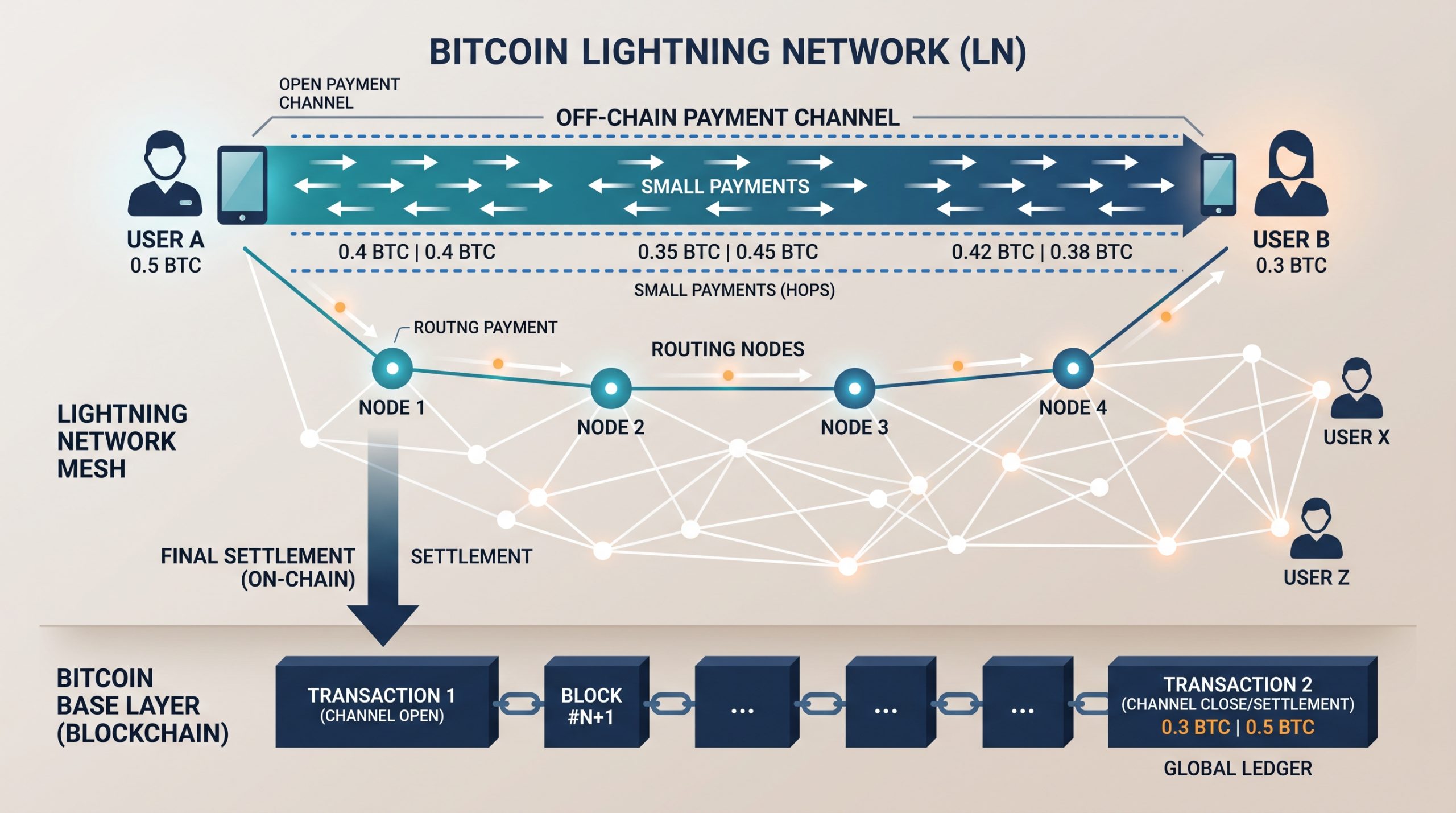


Bitcoin’s scalability challenges have long been a roadblock for mainstream cryptocurrency adoption. The Lightning Network emerges as a promising solution that could change how digital transactions are processed by enabling faster and more cost-effective payments across the blockchain. The Lightning Network offers a second-layer protocol that sits atop the Bitcoin blockchain, allowing for near-instantaneous micropayments with significantly reduced transaction fees. With growing interest from developers, financial institutions, and tech companies, the Lightning Network stands poised to transform how we think about digital payments. Its ability to process thousands of transactions per second could be the key to unlocking Bitcoin’s true potential as a practical everyday currency.
Key Takeaways
- Lightning Network scales Bitcoin transactions: As a second-layer protocol, the Lightning Network addresses Bitcoin’s scalability challenges by enabling near-instantaneous, low-cost micropayments across a decentralized network.
- Global adoption is growing: River estimated $1.17 billion in monthly transaction volume across 5.22 million transactions in November 2025, and publicly measured volume grew roughly 266% year over year.
- Transformative benefits across user groups: From cryptocurrency traders to small businesses and remittance services, the Lightning Network offers reduced transaction fees, faster processing times, and enhanced financial accessibility.
- Technical complexity remains a barrier: Despite its potential, the network faces challenges including steep learning curves, complex cryptographic protocols, and limited user-friendly interfaces that may slow mainstream adoption.
- Emerging use cases expand beyond cryptocurrency: The Lightning Network is poised to reshape micropayments, cross-border remittances, IoT transactions, and decentralized finance by providing efficient, secure, and low-cost transaction mechanisms.
Understanding the Lightning Network
The Lightning Network represents a transformative second-layer protocol for Bitcoin transactions. It enables rapid, low-cost micropayments by creating an additional network layer above the primary blockchain infrastructure.
Key Technical Features
- Payment Channels: Create direct bilateral connections between users that enable multiple transactions without recording each one on the main blockchain.
- Routing Mechanisms: Allow seamless value transfer between participants who aren’t directly connected through intermediate nodes.
- Smart Contract Integration: Implement programmable transaction conditions using cryptographic protocols that ensure secure and verifiable exchanges.
- Scalability Enhancement: Support thousands of transactions per second by processing most exchanges off-chain while maintaining blockchain security.
Blockchain Integration
- Multi-Signature Wallets: Require multiple participant signatures to authorize transactions, increasing security and trust.
- Hash Time-Locked Contracts (HTLCs): Enable atomic swaps and cross-blockchain transactions with predefined execution timeframes.
- Commitment Transactions: Track channel state and balance updates without broadcasting every individual transaction to the main network.
- Onchain Settlement: Periodically reconcile Lightning Network channel balances with the primary Bitcoin blockchain to maintain transaction integrity.
Current State of Lightning Network Adoption
The Lightning Network continues to expand its presence in the cryptocurrency ecosystem, and recently published data shows meaningful progress in payment volume and platform support.
Global Adoption Rates
According to River’s third annual State of Lightning report, published on February 19, 2026, the network processed an estimated $1.17 billion across 5.22 million transactions in November 2025 — the first time monthly volume crossed $1 billion. Spark Money’s State of the Lightning Network in 2026 report puts publicly measured volume growth at roughly 266% year over year, with monthly Lightning transactions reaching approximately 12 million by late 2025.
On the infrastructure side, CoinLaw counted 40,986 active channels across 17,436 nodes, holding about 4,870.8 BTC in total channel capacity as of May 30, 2026. Bitcoin users increasingly leverage the Lightning Network for micropayments and cross-border transactions.
Geographic Variations in Implementation
North America
- High concentration of tech-focused cryptocurrency companies
- Regulatory clarity supports network infrastructure development
Latin America
- El Salvador pioneers national Bitcoin integration — close to 90% of Salvadorans aged 15 and older are estimated to have access to Lightning payments by 2026
- Growing adoption in Argentina and Brazil due to currency instability
- Remittance markets show significant Lightning Network potential
Europe
- Germany and Switzerland demonstrate advanced blockchain infrastructure
- Strong developer communities contribute to network growth
- Regulatory frameworks increasingly supportive of cryptocurrency technologies
Asia-Pacific
- India shows emerging Lightning Network interest
- Singapore acts as a regional cryptocurrency innovation hub
- Japan maintains progressive cryptocurrency regulatory environment
Benefits for Different User Groups
The Lightning Network offers unique advantages across various user segments. Its efficient payment infrastructure transforms transaction experiences for multiple cryptocurrency ecosystem participants.
Cryptocurrency Traders
Cryptocurrency traders gain significant operational advantages through Lightning Network integration. The network enables rapid micro-trades with minimized transaction fees compared to traditional blockchain transfers. Traders experience:
- Faster transaction confirmations
- Lower trading overhead costs
- Enhanced trading liquidity
- Real-time settlement capabilities
- Reduced counterparty risks
Small Business Transactions
Small businesses leverage the Lightning Network for streamlined payment processing. The technology enables:
- Instant cross-border transactions
- Reduced payment gateway fees
- Micropayment acceptance, down to payments worth a fraction of a cent
- Secure transaction infrastructure
- Direct customer payment channels
Remittance Services
The Lightning Network transforms international money transfer mechanisms for remittance providers. Key advantages include sharply reduced transfer fees, sub-second transaction speeds, global payment network accessibility, fewer intermediary banking costs, and direct peer-to-peer transfer capabilities. Remittance services in regions with currency instability — such as Argentina and Venezuela — can leverage the Lightning Network for more efficient value transmission.
Challenges in Lightning Network Adoption
The Lightning Network confronts significant barriers preventing widespread cryptocurrency adoption. These challenges span technical, scalability, and user experience domains.
Technical Complexity
Lightning Network implementation requires advanced technical understanding. Developers must master complex cryptographic protocols like multi-signature wallets and hash time-locked contracts (HTLCs). Node operators need sophisticated knowledge about channel management techniques, routing algorithms, smart contract configuration, and blockchain interaction protocols. The intricate technical requirements can limit participation to specialized professionals with deep blockchain expertise.
Scalability and Liquidity Constraints
Network congestion can emerge when transaction volumes increase. Limited channel liquidity and routing complexity restrict seamless value transfers, and infrastructure must keep pace with growth in demand.
User Experience Barriers
- Complex wallet configuration processes
- High technical entry barriers
- Inconsistent transaction confirmation times
- Limited user-friendly interfaces
- Minimal educational resources for new users
The lack of intuitive interfaces discourages non-technical participants from engaging with Lightning Network technologies.
Major Players and Platforms
The Lightning Network has attracted significant attention from key industry participants across cryptocurrency exchanges, wallet providers, and payment processors.
Bitcoin Exchanges Supporting Lightning
Several prominent cryptocurrency exchanges have integrated Lightning Network support to enhance transaction efficiency. Binance enables Lightning Network withdrawals for Bitcoin, while OKX and Bitfinex have also implemented Lightning capabilities. Coinbase, Kraken, and Bitget all support Lightning deposits and withdrawals, and Coinbase Lightning withdrawals now account for more than 15% of its total bitcoin withdrawals, per Spark. Coinbase integrated Lightning through Lightspark in April 2024, and Xapo Bank reached 23% Lightning adoption within 12 months of launch, according to River’s report.
Wallet Providers
- BlueWallet: Non-custodial Lightning wallet with mobile support
- Muun Wallet: Simple Lightning and on-chain Bitcoin transactions
- Breez Wallet: Integrated Lightning node with instant channel creation
- Phoenix Wallet: Automatic channel management and zero-configuration setup
- Zap Wallet: Advanced Lightning Network trading capabilities
Payment Processors and Platforms
- Strike enables instant Bitcoin payments using Lightning Network infrastructure
- OpenNode provides merchant payment solutions with Lightning integration
- BTCPay Server offers self-hosted payment processing for businesses
- Globee supports Lightning Network transactions for international payments
Mainstream payment platforms are leaning in as well. Block’s Square division switched Bitcoin Lightning payments on by default for all eligible merchants globally on March 30, 2026. Cash App processes roughly one in four Bitcoin payments over Lightning rails, with 7x growth in Lightning usage, per River’s report. CoinGate reports that Lightning’s share of its Bitcoin payments more than doubled from 6.5% in Q2 2022 to 16.6% in Q2 2024, with Lightning order count growing 28.4% year over year versus Q2 2023.
Future Potential and Predictions
The Lightning Network continues to expand its technological capabilities and potential applications. As blockchain scalability becomes increasingly critical, the network presents innovative solutions for cryptocurrency transactions. Key emerging use cases include:
- Micropayments: Support content monetization platforms and seamless digital tipping mechanisms with very small payments.
- Cross-Border Remittances: Cut transfer costs, speed up international transfers, and bypass traditional banking infrastructure.
- Internet of Things (IoT) Payments: Support machine-to-machine microtransactions and programmable, device-level payment systems.
- Decentralized Finance (DeFi) Integration: Accelerate smart contract execution, minimize confirmation times, and reduce blockchain network congestion.
Ongoing development focuses on enhanced routing algorithms that optimize payment channel selection, advanced security protocols built on multi-signature authentication and hash time-locked contracts, scalability improvements that expand concurrent payment channels and throughput, and user experience upgrades that simplify wallet configuration and lower technical barriers to entry.
Economic Impact of Lightning Network
The Lightning Network introduces substantial economic advantages for Bitcoin transactions by transforming cost structures and payment efficiency.
Transaction Cost Reduction
The Lightning Network dramatically reduces transaction fees compared to traditional Bitcoin blockchain transfers, with typical micropayments costing a fraction of a cent. The network achieves cost efficiency through off-chain transaction processing, minimal blockchain interaction, aggregated payment channel settlements, and reduced computational overhead.
Speed of Micropayments
The Lightning Network accelerates transaction processing for micropayments, enabling near-instantaneous value transfers with minimal latency across global payment channels. Its routing algorithms optimize transaction speed by selecting the most efficient payment paths between nodes, ensuring rapid value transmission with minimal friction.
Conclusion
The Lightning Network represents a pivotal breakthrough in cryptocurrency scalability and transaction efficiency. You’ve seen how this technology can transform Bitcoin’s potential by enabling faster, cheaper, and more flexible transactions, and how major exchanges and payment platforms are already routing meaningful Bitcoin volume over Lightning rails. While challenges around complexity and user experience remain, the trajectory looks promising. You can expect continued refinement of the network’s infrastructure, which will make cryptocurrency transactions more accessible and practical for everyday users worldwide.
Frequently Asked Questions
What is the Lightning Network?
The Lightning Network is a second-layer protocol built on top of the Bitcoin blockchain that enables faster, cheaper, and more scalable transactions. By creating payment channels between users, it allows multiple transactions to occur off-chain, reducing congestion on the main blockchain and dramatically lowering transaction fees while increasing processing speed.
How does the Lightning Network improve Bitcoin transactions?
The Lightning Network enhances Bitcoin transactions by processing most payments off-chain through direct payment channels. This approach reduces transaction fees, increases processing speed to nearly instantaneous, and enables micropayments. Users can conduct multiple transactions without recording each one on the blockchain, significantly improving scalability and efficiency.
What are payment channels in the Lightning Network?
Payment channels are direct, secure connections between two users that allow multiple transactions without recording each one on the blockchain. Once users open a channel, they can conduct numerous transactions quickly, settling the final balance on the main blockchain when the channel closes.
Is the Lightning Network secure?
Yes, the Lightning Network maintains Bitcoin’s core security principles through advanced cryptographic techniques. It uses multi-signature wallets, hash time-locked contracts (HTLCs), and commitment transactions to ensure secure exchanges. Each transaction is cryptographically signed, and users can always verify their channel’s state, preventing unauthorized fund transfers.
What are the main benefits of the Lightning Network?
The Lightning Network offers dramatically reduced transaction fees, near-instantaneous transaction processing, support for micropayments, increased scalability, and enhanced privacy. It enables Bitcoin to function more effectively as a day-to-day payment method by overcoming traditional blockchain limitations.
Who can use the Lightning Network?
Anyone with Bitcoin can potentially use the Lightning Network, including individual users, traders, small businesses, and financial institutions. Wallet providers like BlueWallet, Muun Wallet, and Zap Wallet offer Lightning Network-compatible solutions. However, some technical knowledge is currently required, which may limit widespread adoption.
What challenges does the Lightning Network face?
The Lightning Network confronts several challenges, including technical complexity, limited user experience, scalability constraints, and routing difficulties. Current barriers include advanced implementation requirements, network congestion potential, complex wallet configurations, and inconsistent transaction confirmation times. Ongoing development aims to address these limitations.
How fast are transactions on the Lightning Network?
Transactions on the Lightning Network are extremely fast, typically confirming in about a second — far faster than confirmations on Bitcoin’s base layer. This speed makes it suitable for micropayments and real-time transactions.
What is the current state of Lightning Network adoption?
Adoption is growing: River estimated $1.17 billion in monthly volume across 5.22 million transactions in November 2025, and CoinLaw counted 40,986 active channels across 17,436 nodes as of May 30, 2026. Countries like the United States, El Salvador, Argentina, and parts of Europe show significant interest and implementation.
Can the Lightning Network handle international transactions?
Yes, the Lightning Network excels at international transactions. It enables near-instant, low-cost cross-border payments by routing transactions through multiple nodes. This capability is particularly beneficial for remittance services and international commerce, offering significant advantages over traditional banking systems in terms of speed and cost.